Reduced fiduciary liability
Wilshire accepts fiduciary responsibility for fund selection and replacement, taking that burden off your plate.


Wilshire Advisors, an independent investment fiduciary, was engaged to review and improve your plan's investment lineup. Rather than a long list of index funds with some sector overlap, Wilshire's investment team conducts an ongoing review, making decisions designed to improve returns, manage downside risk, reduce complexity, and lower costs. There's nothing you have to do for this change at this time.










Wilshire now serves as your plan's 3(38) investment manager, reducing your fiduciary liability. Following an independent Wilshire review, your plan's legacy menu is being replaced with a simpler, low-cost, three-tier lineup. For a clean, consistent transition to the new investment options, all balances and future contributions will be set to the plan’s QDIA. This will happen in two parts for your employees.
First, on the effective date, savers will get access to the new investment options on the effective date outlined in your email and new contributions will begin to be invested in your plan’s QDIA. Then, on the rebalance date, unless savers make their own investment selections first, their existing balance moves into your plan's default option. Both of these dates are included on our email to you, our email to your savers, and on the Saver Portal. This two step process allows savers to explore and make their own selections into the new investment options ahead of the rebalance date.
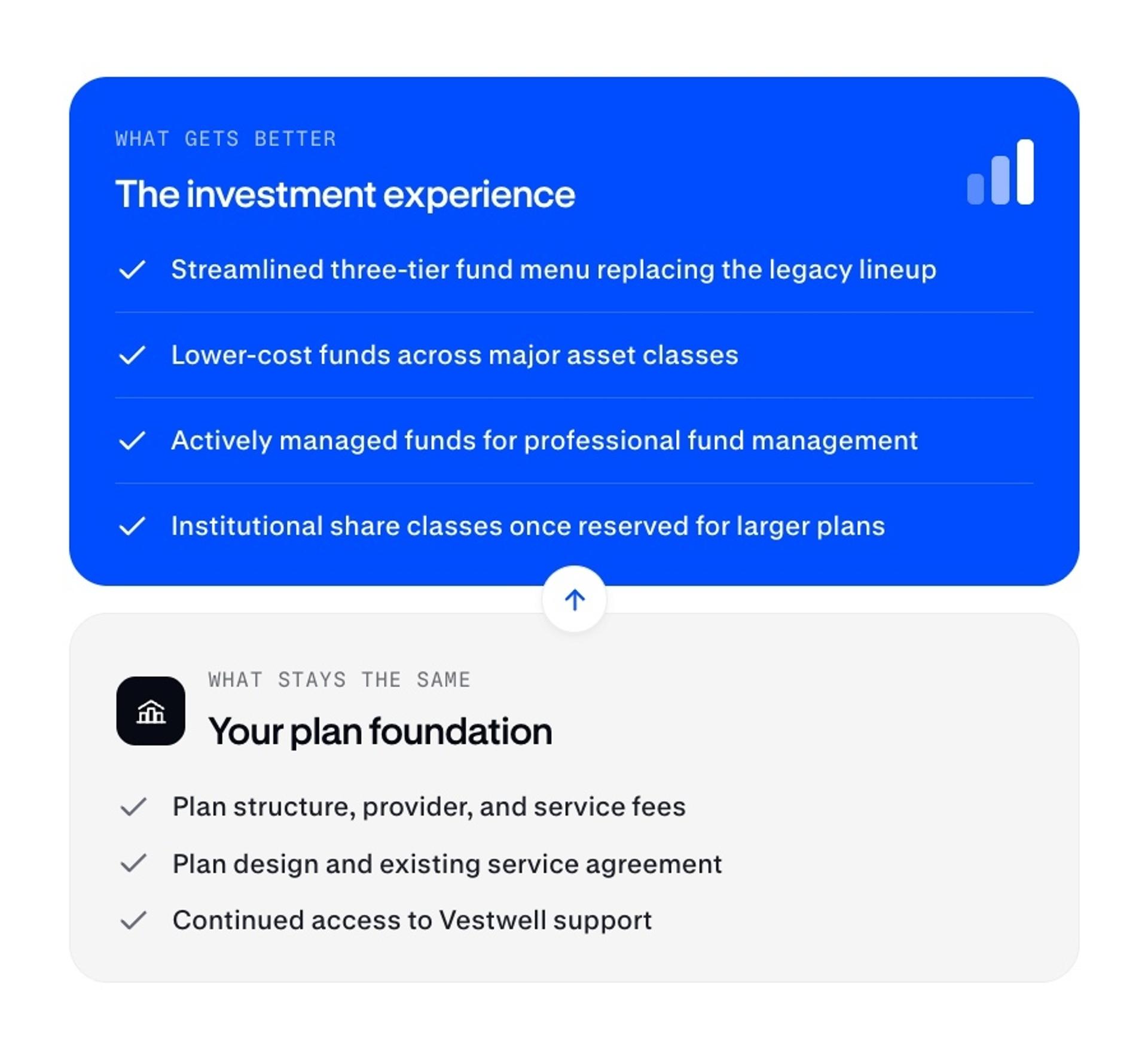
Your plan design, provider, fees, and Vestwell support remain unchanged.
Wilshire accepts fiduciary responsibility for fund selection and replacement, taking that burden off your plate.
The new core index funds cost 40 to 69% less than the legacy retail Vanguard funds they replace, at no additional cost to you.
A three-tier structure replaces a long, overlapping fund list, making it easier for you to explain your plan's investment options to employees and for savers to make informed investment decisions.
Wilshire's scale brings your employees access to Collective Investment Trusts (CITs) with institutional pricing typically reserved for much larger retirement plans.
Goal-based investing is available as an option for your plan's default or as an added feature, giving employees access to more personalized asset allocation tools based on their financial goals.
Wilshire is responsible for selecting, monitoring, and replacing investment options when appropriate, helping keep the lineup focused on saver outcomes.

Your plan's investments are now organized into three tiers, giving your employees a clear path based on how involved they want to be:

There is no action required on your part, but we recommend making sure your savers have received and read our email on the upcoming investment line up changes.

No action is needed. We will be notifying your employees directly a minimum of 30 days prior to your effective date. We recommend reviewing the FAQs, watching our recorded Wilshire Fund Change video, and exploring the new investment line up details.
Your plan's new investment lineup goes into effect. Saver elections and future contributions are mapped according to your plan's selected default investment option (QDIA) and they can begin exploring the new investment lineup and strategies to find what works best for them.
Unless savers have already made new selections in the new investment line up, existing balances are moved in your plan's selected default investment option (QDIA). If they made new investment selections prior to this date, those selections will be used for their rebalance instead of the plan QDIA. Savers can log in anytime to review or update their investment elections.

Goal-based investing gives your employees more personalized asset allocation tools based on their financial goals, factoring in not just their age but also retirement goals, salary, risk tolerance, outside accounts, and Social Security benefits.

Employees will be analyzed by the engine using their age, compensation and current balance (where available) and assigned an appropriate asset allocation.
Learn more about goal-based investing
Providing more information such as their retirement income goal, outside assets, social security, etc. As they provide more information, the engine can refine their allocation and, when needed, reallocate them into a different model. If they’re off track relative to their stated goal, it may also surface suggestions such as saving more, retiring later, or lowering their retirement income goal.
Learn more about goal-based investing
Goal-based investing remains available as an added feature for any employee who wants it
Learn more about goal-based investing
You pay no additional fee for offering goal-based investing. Employees who are enrolled in the service are charged a 0.35% Managed Account Platform fee. This is calculated using their average daily balance for the days that they are enrolled in the service. It is calculated and deducted from the account monthly and shown on their statement, in addition to the underlying fund expense ratios. Employees who prefer a target date fund, a risk model, or a custom allocation are not charged a managed account fee.
Learn more about goal-based investing
Explore fund fact sheets, performance data, and expense ratios for every option in your plan's new lineup.
Vestwell has engaged Wilshire Advisors to serve as your plan's investment fiduciary. In this role, Wilshire takes on full discretionary authority and fiduciary responsibility for selecting, monitoring, and, when appropriate, replacing the investment options in your plan. Founded in 1972, Wilshire partners with 300+ institutional investors and financial intermediaries globally and oversees $1.5+ trillion in assets, including $1+ trillion for retirement plan clients. Wilshire is fully independent, with no affiliation to Vestwell or your prior provider.


Following an independent review by Wilshire, your plan’s legacy investment menu will be replaced with a streamlined lineup designed to make the investment experience easier to understand and more cost-effective for employees.
The updated lineup will include:
Wilshire serves as the plan’s ERISA Section 3(38) investment manager for the selected investment options. In this role, Wilshire has discretionary authority to select, monitor, and replace those options, subject to the plan and applicable law. This helps reduce the fiduciary liability, investment-selection, and monitoring responsibilities carried by your organization.
Your plan design, provider, service agreement and fees, and access to Vestwell support will remain unchanged.
On your effective date, saver elections and future contributions will be mapped into the plan’s Qualified Default Investment Alternative, or QDIA, as part of the transition to the updated lineup.
The QDIA is the default investment option selected for your plan during your transition to Vestwell. Depending on the selection made at that time, either Age-Based Target Date Funds or Goal-Based Investing.
Savers may log in to review the new investment options and make changes to their elections. Savers who currently manage their own investment mix and wish to continue doing so may select their preferred options at that time. Employees who do not take any action, will continue to be invested in their plan’s QDIA.
On your rebalance date, saver existing balances will be moved into the plan’s QDIA, to finalize the transition to the updated lineup. If they made new investment selections prior to this date, those selections will be used for their rebalance instead of the plan QDIA.
There are two key dates related to this change: the effective date and the rebalance date.
Both are specific to your plan, please reference our email for the dates specific to your plan.
Wilshire Advisors is an independent, third-party investment fiduciary, among the largest in the industry. As your plan’s fiduciary investment manager, Wilshire selects, monitors, and replaces (if and when needed) the investment options in your plan.
No. Wilshire Advisors is a fully independent third-party fiduciary, not affiliated with Vestwell, Accrue, or Guideline. Their independence and their fiduciary role means their obligation is to act in your employees’ best interests when selecting and monitoring investments.
Having an investment manager like Wilshire means they are responsible for selecting and monitoring the plan’s investments. As an employer, you are always required to maintain general oversight of your plan, but Wilshire’s role reduces your fiduciary investment liability.
No. The entity providing investment oversight changed from Guideline Investments to Wilshire Advisors, but your plan’s service fees remain exactly as outlined in your service agreement. The investment lineup changes that Wilshire implemented reduce the fund-level expenses your employees pay.
Wilshire, as your independent investment fiduciary, completed its review of the investment options that were available to your plan when it was supported by Guideline and determined that a lineup redesign will benefit your employees. The Guideline lineup included a large number of funds, which created unnecessary complexity, higher costs, and sector overlap with other funds in the lineup, which may have given savers a false sense of diversification. A large lineup also creates potential increased fiduciary risk for employers. Additionally, Wilshire was able to leverage its market position to introduce less expensive index-tracking alternatives. In short, this lineup change is Wilshire doing exactly what it was engaged to do.
The new lineup is organized into three tiers:
The new core index funds are less expensive than the comparable legacy funds they replace. Expense ratios on funds in the new lineup include:
Lower investment expenses matter because the less paid in fund costs corresponds directly to higher returns and more of each employee’s savings can remain invested for retirement.
CITs (Collective Investment Trusts) are investment vehicles designed for retirement plans. They contain the same underlying investments as mutual funds, but because they are designed for retirement plans, they can often be offered at lower costs. Wilshire has leveraged its scale to negotiate institutional pricing, allowing you to access share classes of these funds typically available only to larger plans, passing those savings directly to your employees.
Savers will receive advance notice of the upcoming lineup change selected by Wilshire. On the effective date, the new lineup takes effect and they will be automatically mapped to the default investment option selected by you as the employer during the Vestwell registration process. New contributions will be invested in the plan’s QDIA.
Savers can stay in the default investment option or select different investments at any time, without penalty.
On the rebalance date, existing balances will be moved to the plan’s QDIA, unless the saver makes a selection in the new line up prior to the rebalance date. If they made new investment selections prior to this date, those selections will be used for their rebalance instead of the plan QDIA.
Savers can stay in the default investment option or select different investments at any time, without penalty.
Wilshire has partnered with Nuveen to create a new institutional target date portfolio series for your retirement plan. The portfolios use Nuveen’s underlying investments and asset glidepath, but are offered through an institutional structure designed for workplace retirement plans. This allows employees to access a similar investment approach at a 40% lower cost: 0.06% compared with 0.10% for the comparable mutual fund offering. Nuveen provides the investment approach and underlying strategies, while Wilshire is responsible for selecting, implementing and monitoring portfolios as the investment fiduciary.
Some investment options may be removed without direct replacement because Wilshire's menu design philosophy seeks to minimize overlapping funds and reduce unnecessary complexity and “choice overload.” While the number of funds may decrease, Wilshire’s lineup maintains diversification and saver flexibility while creating a more efficient investment lineup where each option provides exposure to a distinct asset class, and employees can build diversified portfolios without having to choose among multiple similar funds.
If employees do not make any other investment selections, their accounts will remain invested in your plan’s default option, which is the Age-Based or Goal-Based investments. Regardless of which default investment option the employer selected, both are professionally managed portfolios.
Employees will be defaulted into goal-based investing, which is our managed account feature. The technology uses census data, including age, compensation (if available) and account balance, to invest savers into a portfolio of investment options selected by Wilshire Advisors. Read more about goal-based investing here.
Yes. Goal-based investing remains available as an optional feature for any saver seeking a more personalized investment experience, regardless of the plan’s QDIA election.
The employer pays no additional fee. Employees who choose goal-based investing pay 0.35% annually. This fee is billed monthly, using the employee’s average daily balance for the days that they are enrolled in the goal-based investing feature. Savers who prefer target date funds or a custom allocation pay only the underlying fund expense ratios, with no managed account fee.
A Qualified Default Investment Alternative (QDIA) is the default investment option you as the employer selected as the default for participants who do not select their own plan investments or when the plan’s investment manager initiates a re-enrollment to the plan’s default based on a change to the lineup.
When an employee becomes eligible and is automatically enrolled in your company retirement plan but does not select their own investments during registration, their contributions will be invested in the plan’s default investment strategy.
In addition to being on the email we sent regarding this change, you can see your QDIA in your Portal.
A rebalance is when a saver’s existing balance is moved into the plan’s QDIA on the plan’s scheduled rebalance date.

